
Realistic Sex Doll: Why Weight Changes Everything Day to Day

A realistic 165 cm sex doll frequently weighs over 35 kg. That number often surprises buyers, who discover at delivery that they have to move, wash, and store the equivalent of an adult of flesh and bone — with far less flexibility. Understanding the link between realism and weight prevents unpleasant surprises and helps you choose a model suited to your strength and your home.
Why a realistic doll weighs so much
The weight comes from three factors that add up: the volume of material, the density of the material, and the internal structure. A life-size doll contains a lot of silicone or TPE, and these materials are dense. TPE is generally a little heavier than silicone at equal volume, but the differences remain modest.
Inside, an articulated metal skeleton runs through the body to allow posing. This frame adds several kilos, especially on models with many joints. The more realistic the doll — proportions, bust, hips, sculpted thighs — the more material it contains.
A generous cup size, for example, represents a significant volume. A 157 cm G-cup doll like Lucy, from Funwest, weighs noticeably more than an equivalent B-cup model. It's simple physics: visual realism has a cost in kilos.
Weight benchmarks by height
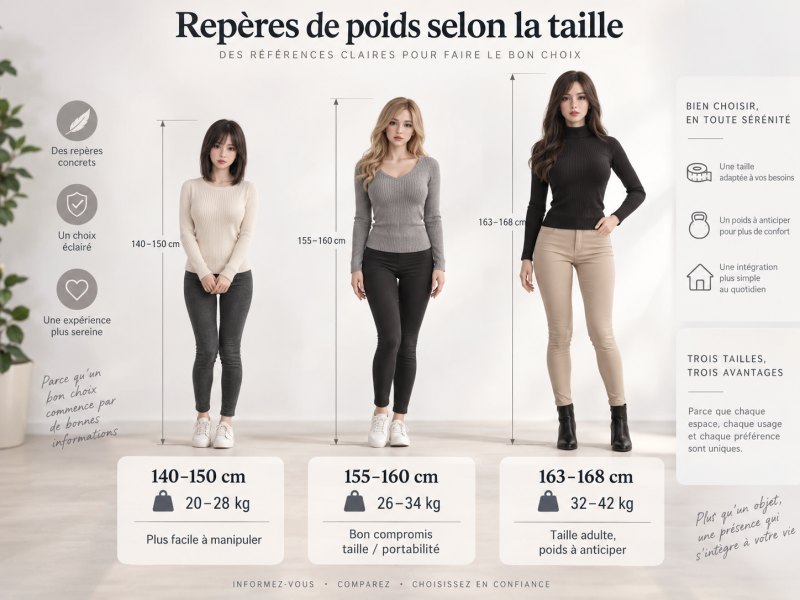
The ranges below are indicative. They vary by brand, material, and the model's build. They mainly serve to give you a sense of scale before comparing two product listings.
| Height | Typical weight | Profile |
|---|---|---|
| 140–150 cm | 20–28 kg | Easier to handle, more compact silhouette |
| 155–160 cm | 26–34 kg | Good compromise between size and portability |
| 163–168 cm | 32–42 kg | Adult size, weight to plan for seriously |
| 170 cm and up | 38–48 kg | Reserved for users comfortable with heavy loads |
These figures refer to the full body. Torsos, which are shorter, often come in under 20 kg and remain an alternative for anyone who wants realism without the burden of total weight.
Weight in concrete terms: a few comparisons
A number in kilos doesn't speak to everyone. Here are some everyday equivalents, approximate but telling.

- 25 kg: a large full suitcase, or a multi-bottle pack of water.
- 35 kg: a medium-sized refrigerator, empty. Except a fridge has handles and takes two people to carry.
- 40 kg: a washing machine. Nobody moves one alone without thinking about their posture.
The difference comes down to grip. A refrigerator is grabbed by rigid handles; a doll is soft, slips, and deforms when you lift it. That's what makes 35 kg of silicone harder to manage than 35 kg of rigid plastic.
What weight changes in real-world use
Carrying and moving
Moving a heavy doll requires technique. Lift it by bending your legs, not your back, and keep the load close to your body. To transfer it from the bed to storage, it's better to carry it in a seated position, arms under the armpits and under the knees, rather than standing and off-balance.
Over short distances, a hand truck or folding cart changes everything. Some users also place the doll on a rolling chair to move it effortlessly.
Storage
A 38 kg doll doesn't slide under a bed without some thought. Ideal storage keeps it lying down, in a neutral position, away from light. If you have to take it out and put it away with every use, weight becomes a decisive criterion in choosing your model.
Positions
Weight directly influences the poses possible. A heavy doll stands better against a support, but its joints are put under more strain. Conversely, a light doll can be repositioned with one hand, which makes experimentation easier.
The skeleton plays a key role here. A rigid, well-articulated frame partly compensates for weight: the doll holds the chosen position without you having to support it constantly.
Choosing between realism and lightness
There's no such thing as a doll that's both perfectly realistic and light. Realism comes from the material, and the material weighs. So the question isn't "which is best?" but "which balance suits me?".
A light yet realistic doll is still possible in smaller sizes. A 155–160 cm TPE model, like the Sydney 163 cm tan hybrid doll from Sigafun, offers a credible look with a more manageable weight than a large silicone doll. Conversely, a large silicone doll like Lexie 168 cm D-cup from Funwest prioritizes realism at the cost of handling.
Ask yourself three questions before buying: where will I store it, alone or with someone, and how many times a week will I move it? The answers guide your choice better than any spec sheet.
Tips for handling a heavy doll without injury
- Plan the route before lifting: nothing on the floor, clear destination.
- Bend your legs, keep your back straight, never twist with the load.
- Carry it against your body, never at arm's length.
- Use a rolling support for regular moves.
- Don't lift it alone if it exceeds your comfortable capacity.
- Store it lying down, in a neutral position, rather than suspended.
One last point that's often overlooked: maintenance. Washing a 40 kg doll in a bathtub means lifting it twice. If you plan to clean it frequently, the weight is as hard on your back as it is on your choice of model.
Recommended products




Frequently asked questions
How much does a realistic sex doll weigh?
Expect 20 to 28 kg for 140–150 cm, 26 to 34 kg for 155–160 cm, and 32 to 42 kg for an adult size of 163–168 cm. Large models sometimes exceed 45 kg.
Can a lightweight sex doll be realistic?
Yes, especially in smaller sizes and in TPE. The visual realism remains good, but the feel and density differ from a heavier doll.
What should I do if my doll is too heavy?
Use a rolling support, carry it in a seated position against your body, and store it at height to avoid repeated lifting. Also consider a torso if total weight becomes a barrier.
Does the skeleton affect weight?
Yes. An articulated metal frame adds several kilos, but improves pose retention and reduces the effort needed to hold it in place.
Can you move a heavy doll alone?
Beyond 35 kg, it's risky for your back. Favor a support or a helper, and avoid twisting movements with the load.
Related articles

Which Sex Doll Brand Is the Most Realistic in 2026?
Silicone texture, permanent makeup, articulation, weight: what truly sets an ultra-realistic doll apart from a nice product photo.

Transgender Sex Doll: The Guide to Choosing a Realistic Trans or Hermaphrodite Sex Doll in Silicone or TPE in 2026
Anatomy, materials, brands, customization and care: everything you need to know before buying a transgender sex doll, a trans sex doll or a realistic hermaphrodite love doll.
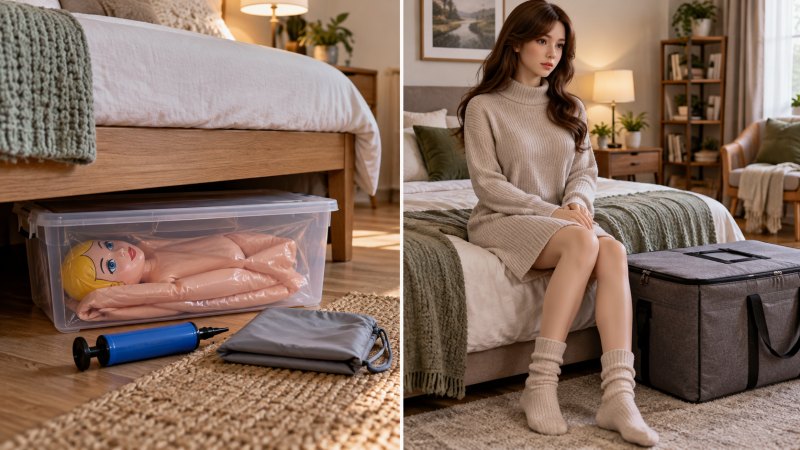
Inflatable Doll vs. Realistic Doll: The Honest Comparison
Materials, sensations, weight, maintenance, real cost over three years: what truly separates an inflatable doll from a realistic silicone or TPE doll.

Cleaning and Maintaining a Silicone Sex Doll: The Complete Guide
Products to use, moves to avoid, drying, disinfecting and storage: the complete method to keep a silicone doll spotless without damaging it.